Great scrambling. Big, big part of the game!
-
-
If you're coming in at a high angle, less spin is needed. The lower the angle, the more spin needed. If you're not trying to duplicate that low angle, high spin shot as referenced in the article you attached, you'll have better success stopping the ball. If you have a solid strike down on the ball, you're hitting a higher launch angle, have a good quality wedge and most importantly a high quality ball (which produces more backspin, like the Pro V1) you'll get the effect you're looking for and perhaps see the ball come back a bit. Something in the 8-9000s won't be difficult. What type of ball and wedge are you using? Also, make certain your wedge grooves are clean!Originally posted by rigasminho View PostComment
-
I can attest to that. Pro v1 I find on average generate at least 2000 rpm more back spin than a Top flight average ball. So it seems the better quality ball (i.e. more expensive) will get you better results.GC2 Eastern Time Zone, USAComment
-
I use Prov1 x and compared it to ZStars and did find the, to on average have more spin. I do want to compare against reg Prov to see what the diff would be for me. However, I agree with others here, don't get caught up with numbers as I suspect that there are a lot of other little things you could work on that round cut 5 plus strokes off your game with practice. Also, when people are saying hit down on the ball, I don't think it is as much as you might think and would suspect coming down on the ball 4 degrees is likely what is needed.Comment
-
Most important things to spin the ball are using a premium urethane cover ball, clean grooves, and solid contact.
Other than that, you can get more or less spin with different impact dynamics. But those three things will have your ball checking up on all but the firmest of greens.
I'd say most important is the ball believe it or not.
I can't spin a 2 piece, surlyn cover, distance ball the same way a ProV1 would no matter how much I try. No way past that, just physics. Soft balls spin more.
Also speed produces spin. that's another way the pros produce a good amount of spin. That's why your not going to see a very slow swing player ripping balls back on the green.Comment
-
Originally posted by goatbarn View Post
I could not agree more with this post. The ball makes all the difference in the world. But if the groves are not sharp and clean it really won't matter a bunch what ball you use.Protee
CST Time zoneComment
-
Exactly...Originally posted by Dax View Post
People always say hit down, i love it... when their ball keeps rolling and they are still yelling "BITE" I yell "RELEASE" lol
Spinning wedge shots is pretty much the reason I own a GC2. There are a ton of factors involved to make a ball bite or backup like greens,slope,launch angle,ball,wedge, ect ect...
I find if I want to hit a 12000+ spinner I need a maxed out 60* swing, I hit from a out-to-in club path while having a open stance. it's important for a open club face while keeping that face open all the way through impact. Too keep it low I would keep the ball a little bit back in the stance, although that would cause me to loose a bit of spin. I like when people use the expression of trying to keep the ball on the face, or to make it climb the face. Hard to explain....This shot needs to be struck very clean and precise. I also use Vokey SM2 wedges with the square grooves and a KBS Rev shaft.
Depending on conditions,angles ect.. I would think that 6500+ would be enough for some decent check, but 8500+ for backspin..
All that being said,spinning the ball WILL NOT help you drop your scores, it will make it worse...trust me these are low percentage shots even for the pro's. They get good spin on their shots because they strike the ball perfectly and the courses they are on are mint. Most of the time they are avoiding spin.
They are sure fun though!
Last edited by DGThread; 03-23-2015, 02:01 AM.Comment
-
Spin numbers for decent check with a sand wedge will be nearly 10,000 rpms. Trackman publishes a tour average report showing launch, ball speed, club speed, angle of attack, etc. for the PGA Tour.
Pitching Wedge
83 mph club speed, 102 mph ball speed, 1.23 smash factor, 9303 rpms ball spin, -5.0 degrees angle of attack, 24.2 degrees launch angle, 52 degrees landing angle, 89 feet Max. height, 137 yards Carry distance.
Sand wedge at 56 degrees loft will have highest spin rates, even more than lob wedge at 60 degrees, because after 56 degrees of loft, the ball is not compressed as much with a 60 degree lob wedge due to the ball slides more up the face, i.e. more of a glancing blow with less compression.
Compare the LPGA tour average with the PGA Tour average for the pitching wedge. Notice the Ladies spin rate is 900 rpm less. Watch the televised golf events for both tours and you will see that the women do not get much spin and stop, their shots typically run out more like you see within the amateur ranks.
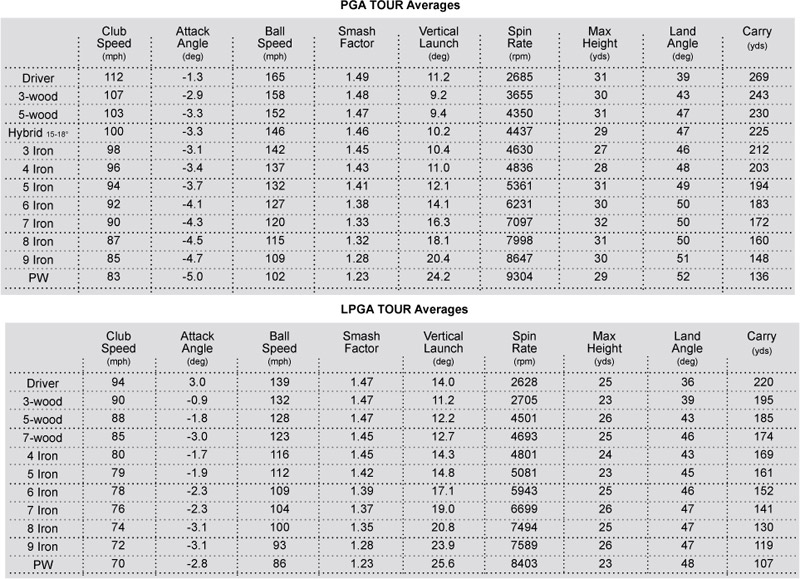
Comment
-


Comment